If you have tried to chart NIFTY, BANKNIFTY or CRUDEOIL in MetaTrader 5, you have already discovered the awkward truth: MT5 is an excellent platform with no idea that Indian markets exist. This guide walks through every way to fix that in 2026, what each one actually costs, and the specific failure that catches most people out — option chains.
Why MetaTrader 5 has no NSE data to begin with
MetaTrader is a terminal, not a data provider. When a forex broker hands you MT4 or MT5, the feed comes bundled because that broker is the counterparty quoting prices. Indian equity and derivatives markets do not work that way. NSE, BSE and MCX are order-driven exchanges, brokers are members routing your orders to them, and no Indian broker ships an official MetaTrader build with an exchange feed attached.
So MT5 arrives empty. The platform is free, capable and widely known — and completely blind to the instruments you trade. Everything below is about closing that gap.
Route 1 — A third-party vendor's MT4 or MT5 server
The most advertised option. A vendor runs their own MetaTrader server, feeds it with exchange data they license, and gives you login credentials. You install MetaTrader, connect to their server, and charts appear.
It works, and for plain index or equity charting it can be perfectly adequate. But understand what you have bought:
- You are not connected to your broker. You are connected to a company republishing a feed. Your prices, your uptime and your symbol list are all their decisions.
- The symbol list is fixed. You get whatever they pre-loaded. This is the killer for options — more on that below.
- Cheaper tiers often use offline charts. Data arrives as
.hstfiles rather than a live tick stream. Offline charts cannot drive live Expert Advisors and have no real Market Watch. - Execution is usually separate. Charts on their server, orders in your broker's app, and you bridging the two by hand.
If someone offers you real-time NSE data on MetaTrader 4, this is always the route they mean. There is no other way to do it on MT4 — and it is why MT4 setups never show a full option chain.
Route 2 — Your own broker API, bridged into MT5
Every major Indian broker now publishes a developer API: Zerodha's Kite Connect, Fyers, Dhan, Angel One, Finvasia's Shoonya, Flattrade. These give you programmatic access to the same live data and order placement your broker's own app uses. We compare them in MetaTrader 5 with Indian brokers, broker by broker.
A bridge application sits between that API and MetaTrader 5. It authenticates with your keys, subscribes to the instruments you want, and writes them into your terminal as live symbols. The data path is broker → your PC → your MT5. Nobody else is in it.
This is the route we build, so treat the recommendation with appropriate scepticism — but the structural advantages are real and worth stating plainly:
- Prices are your broker's prices, the same ones your orders execute against.
- You choose the symbols, including strikes that no vendor would pre-load.
- Data is a live tick stream, so Expert Advisors and alerts work normally.
- Order execution can run through the same connection, from the chart.
- If the vendor disappears, your broker API does not.
The trade-off is that you pay for API access separately and you run software locally. It is not a hosted service.
Before you pay for any route
See Indian stocks in MetaTrader 5 today — free
Our free NSE EOD Bridge loads 2,600+ NSE stocks into MetaTrader 5 from official NSE Bhavcopy data. End-of-day, not real-time — but it writes custom symbols into your own terminal exactly as Route 2 does, and it costs nothing: no broker account, no API subscription, no signup.
Get the free EOD Bridge →Route 3 — Roll your own
Kite Connect has a well-documented Python SDK, and MetaTrader 5 exposes a Python integration. A capable developer can absolutely build a personal bridge.
People underestimate what "finished" means here, though. A weekend prototype streams ticks. A tool you would trust with money also has to handle access-token expiry at 6am, WebSocket reconnection, PC sleep and wake, backfilling the gap after a restart, correct candle closes at 15:30 and the 15:40 F&O close, symbol lifecycle across weekly expiries, and the broker's order-rate limits. That is the long tail that turns a two-week project into a six-month one.
Worth doing if you enjoy building infrastructure. Worth buying if you would rather be trading.
The option chain problem
This is the single most useful thing to understand before you pay anyone, and it is the reason so many traders churn through vendors.
MetaTrader 4 has no API for creating symbols. A vendor can only show you contracts they loaded on their server in advance. A live NIFTY chain across a few expiries is several hundred strikes; add BANKNIFTY, SENSEX and stock options and you are into the thousands, changing every week. No vendor pre-loads that, which is why MT4 setups show you indices and futures and then quietly stop.
MetaTrader 5 introduced CustomSymbolCreate. An application can inject any contract into your terminal as a first-class symbol — chartable, indicator-ready, EA-ready. That single API is the difference between "MetaTrader for Indian markets" being a compromise and being genuinely useful.
| Vendor MT4 server | Vendor MT5 server | Your broker API + bridge | |
|---|---|---|---|
| Data source | Their server | Their server | Your broker, direct |
| Symbol choice | Fixed list | Usually fixed list | Anything tradable |
| Stock option strikes | Not possible | Sometimes limited | Any strike, any expiry |
| Live ticks for EAs | Often offline charts | Yes | Yes |
| Timeframes | 9 | 21 | 21 |
| Order execution | Separate | Sometimes | From the chart |
| Runs when your PC is off | Yes | Yes | No — it runs locally |
That last row is a genuine drawback of the API route and we would rather say so than let you discover it later. The bridge runs on your machine, so your machine has to be on during market hours. Traders who need 24/7 uptime typically run it on a small VPS.
What it actually costs
There are two separate bills, and vendors who quote one number are usually hiding one of them.
- Broker API access. Zerodha lists Kite Connect at around ₹500/month. Paid to the broker, not to any software vendor. Check kite.trade for current pricing.
- Bridge software. Ours starts at ₹999/month; others differ. MetaTrader 5 itself is free.
- A static IP, if you intend to place orders — see below. Usually a small ISP add-on.
Five pitfalls worth knowing before you start
1. The static IP requirement is real
Under SEBI's framework for retail participation in algorithmic trading, order placement through a broker API requires a registered static IP. Charting alone does not. Plenty of people buy a data solution, then find they cannot place orders from it.
2. Access tokens expire daily
Kite Connect tokens are valid for a single trading day. Any workable setup logs in automatically each morning; if yours does not, you will be pasting a token before every session.
3. The 15:40 F&O close
NSE's derivatives session now closes at 15:40 while equities close at 15:30. Software written before that change writes the final candle at the wrong time, or drops the closing print into the 15:29 bar. Ask any vendor directly how they handle it.
4. Sleep, wake and dropped connections
A laptop that sleeps mid-session must reconnect and backfill what it missed. Reconnecting alone leaves a hole in your chart that every indicator will happily calculate through.
5. Order-rate limits
Brokers cap unregistered retail algo order flow at under 10 orders per second. Well-built software enforces that; software that does not will eventually get your API access throttled.
So which route should you take?
- Index and equity charting only, and you would rather not run anything locally — a vendor MT5 feed is fine.
- You trade options, or want EAs on your own strikes — you need the broker-API route. Nothing else can give you the chain.
- You are a developer who enjoys infrastructure — build it, and budget more time than you think.
- You are still on MT4 — the honest answer is that MT4 cannot do what you want. Why NSE data will not work properly on MetaTrader 4, and the full comparison.
Common questions
Does MetaTrader 5 come with NSE data?
No. MT5 is a platform, not a data source, and no Indian broker publishes an official MT5 feed. You supply the data yourself, via a vendor server or your own broker API.
Can I use my Zerodha account to get data into MetaTrader 5?
Yes — through Kite Connect plus a bridge application that translates the API feed into MT5 symbols. Kite Connect is a paid developer subscription, billed separately from your trading account.
Why can't I get individual stock option strikes on MT4?
MT4 has no custom-symbol API, so vendors can only serve a pre-loaded list. A full chain is hundreds of strikes changing weekly. MT5's CustomSymbolCreate is what makes it possible.
What does it cost to get real-time NSE data in MT5?
Two bills: broker API access (Zerodha lists Kite Connect around ₹500/month) and the bridge software (ours from ₹999/month). MetaTrader 5 is free.
Do I need a static IP?
Only for placing orders, not for charting — it is a SEBI requirement for retail algo order flow.
What the broker-API route looks like in practice
Disclosure: these are screenshots of our own tool, the TradexCodez MT5 Bridge, included so you can see what route 2 actually produces rather than taking the description on trust. Every other vendor mentioned above is worth evaluating on the same basis — ask them for equivalent screenshots before you pay.
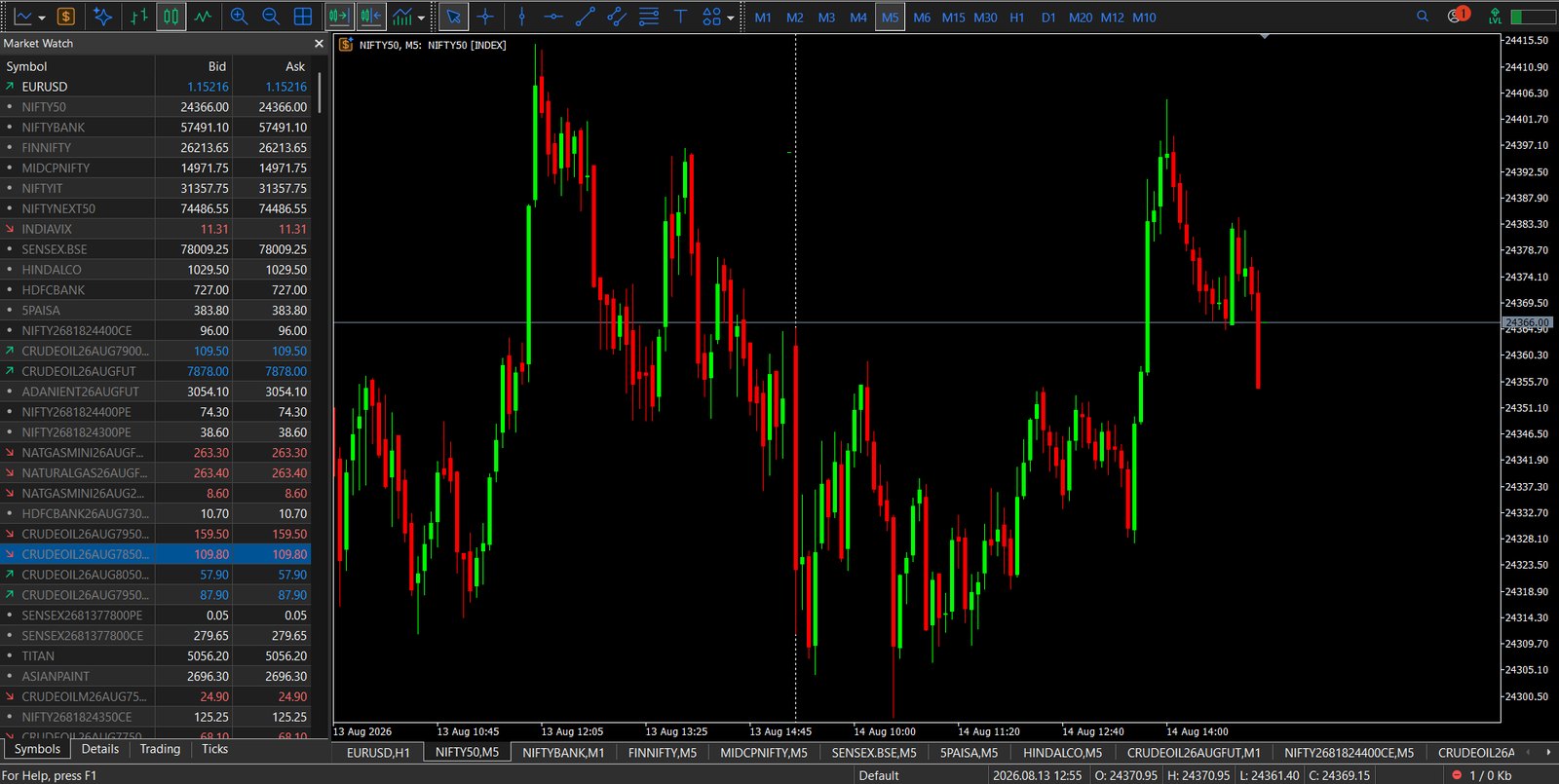
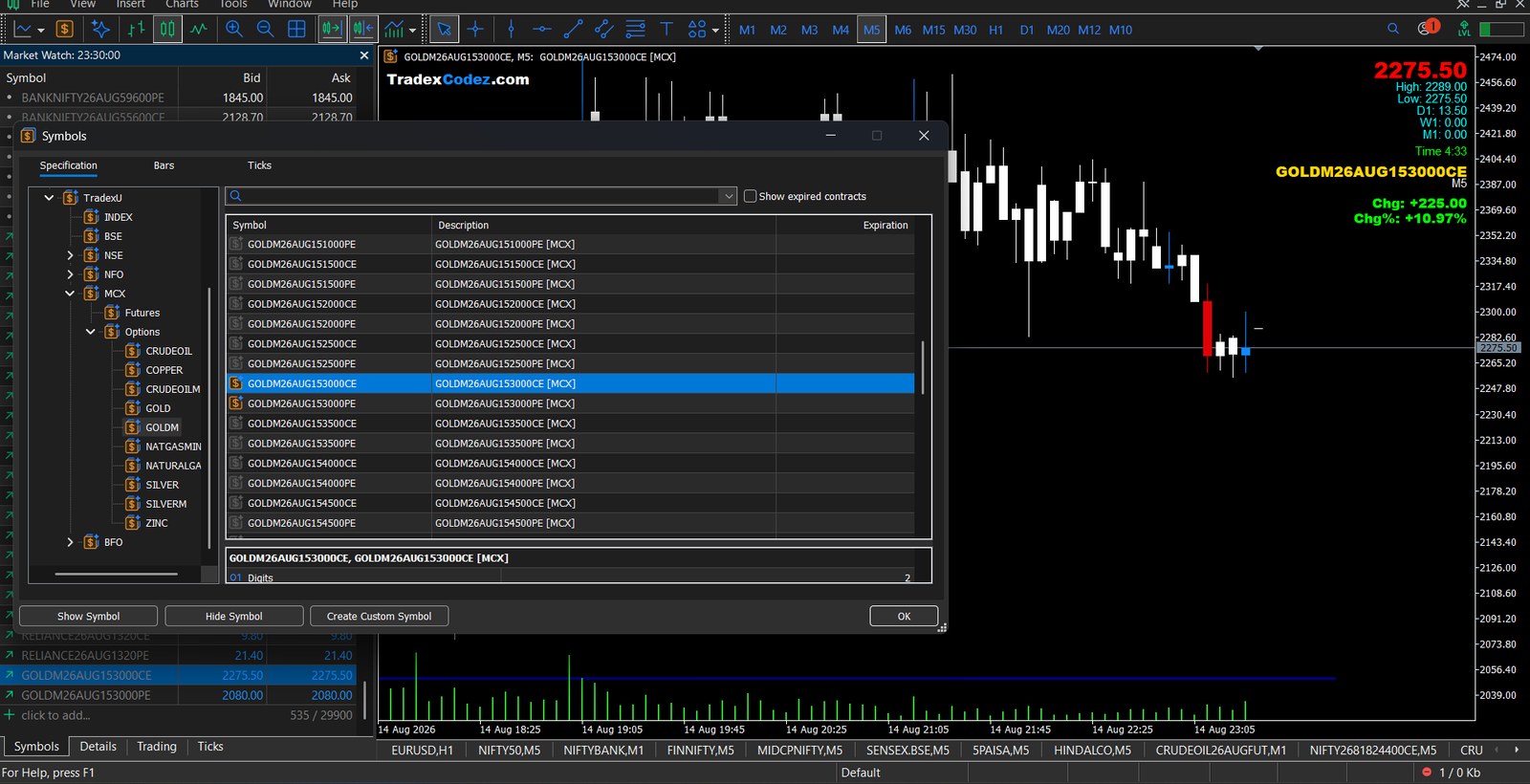
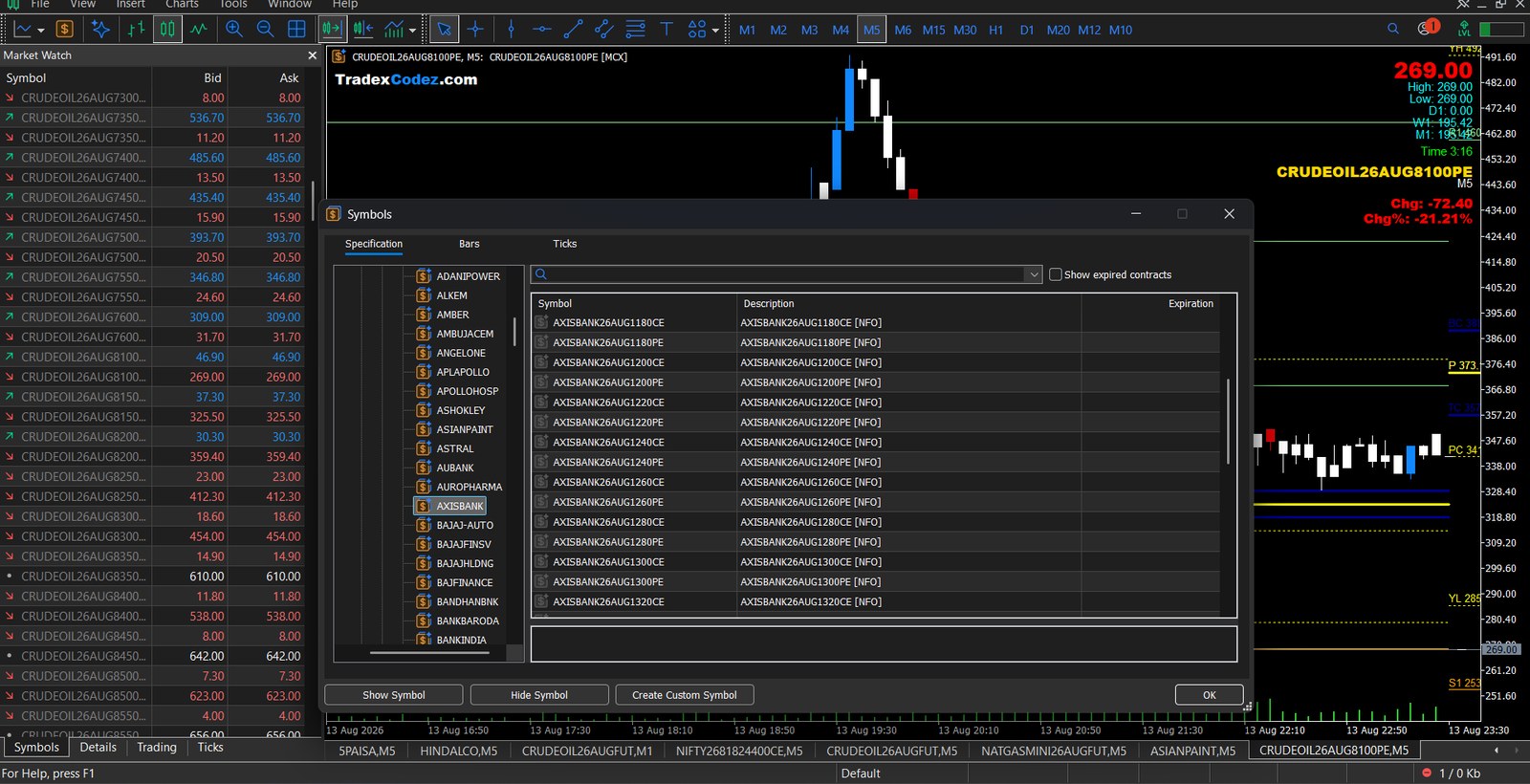
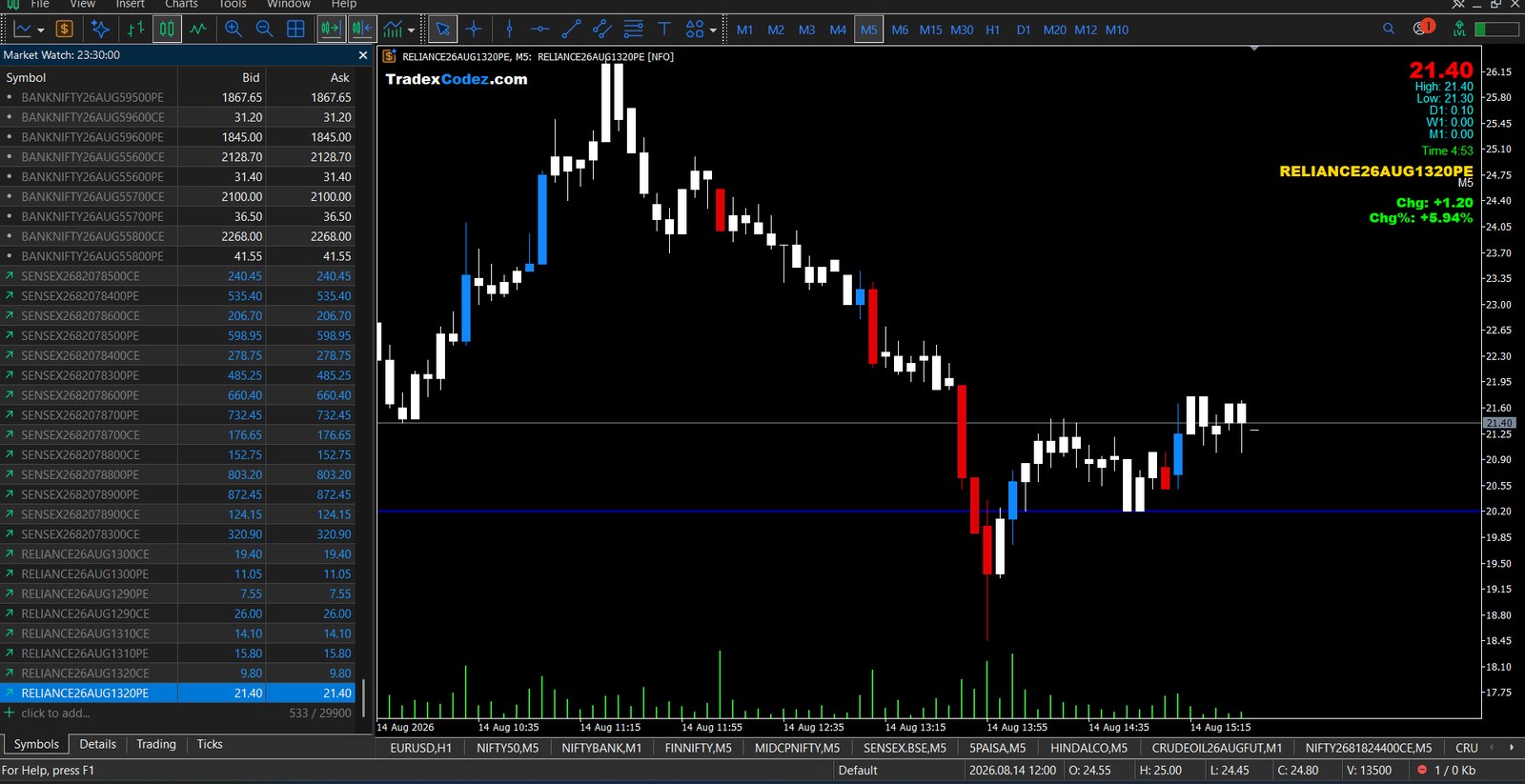
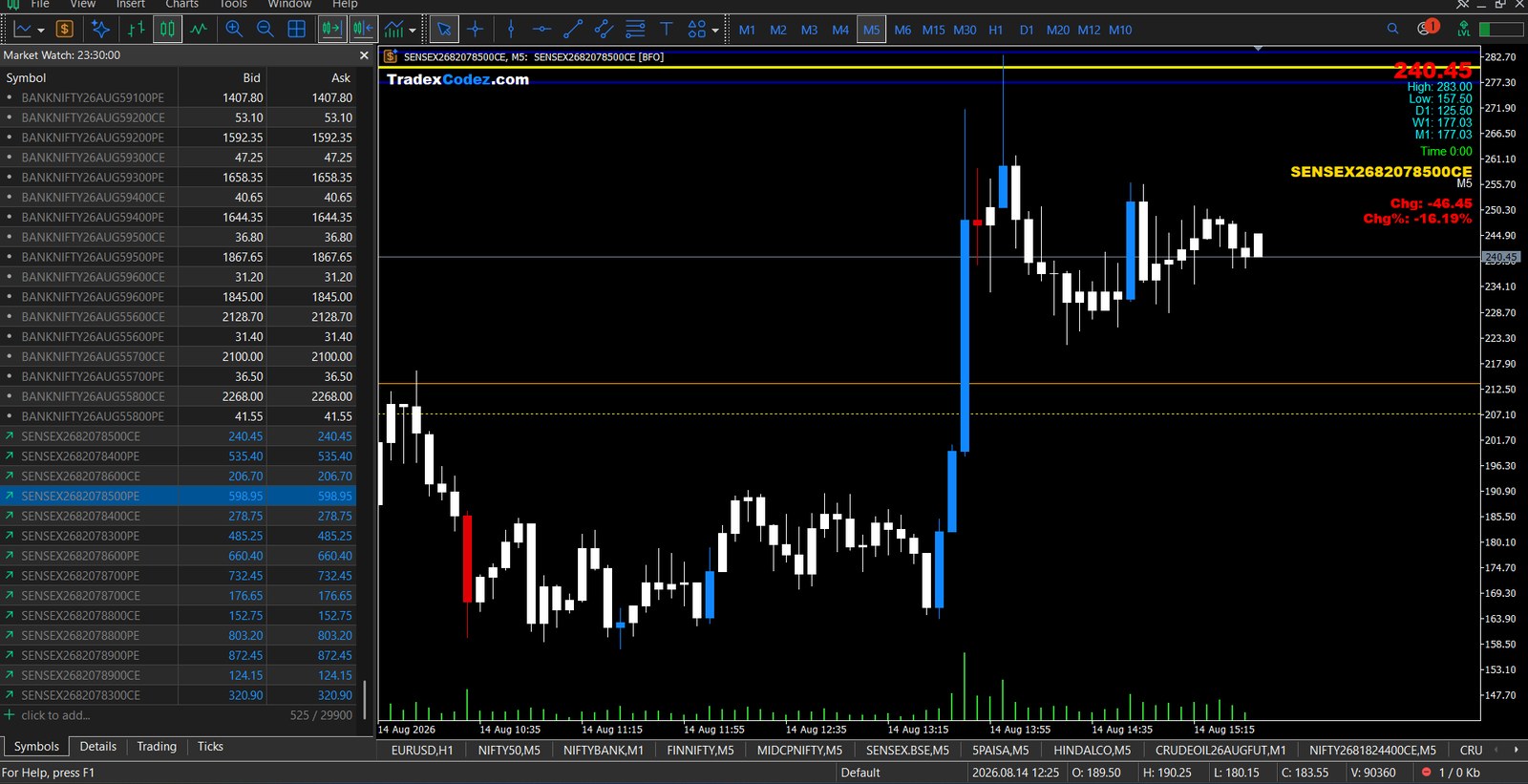
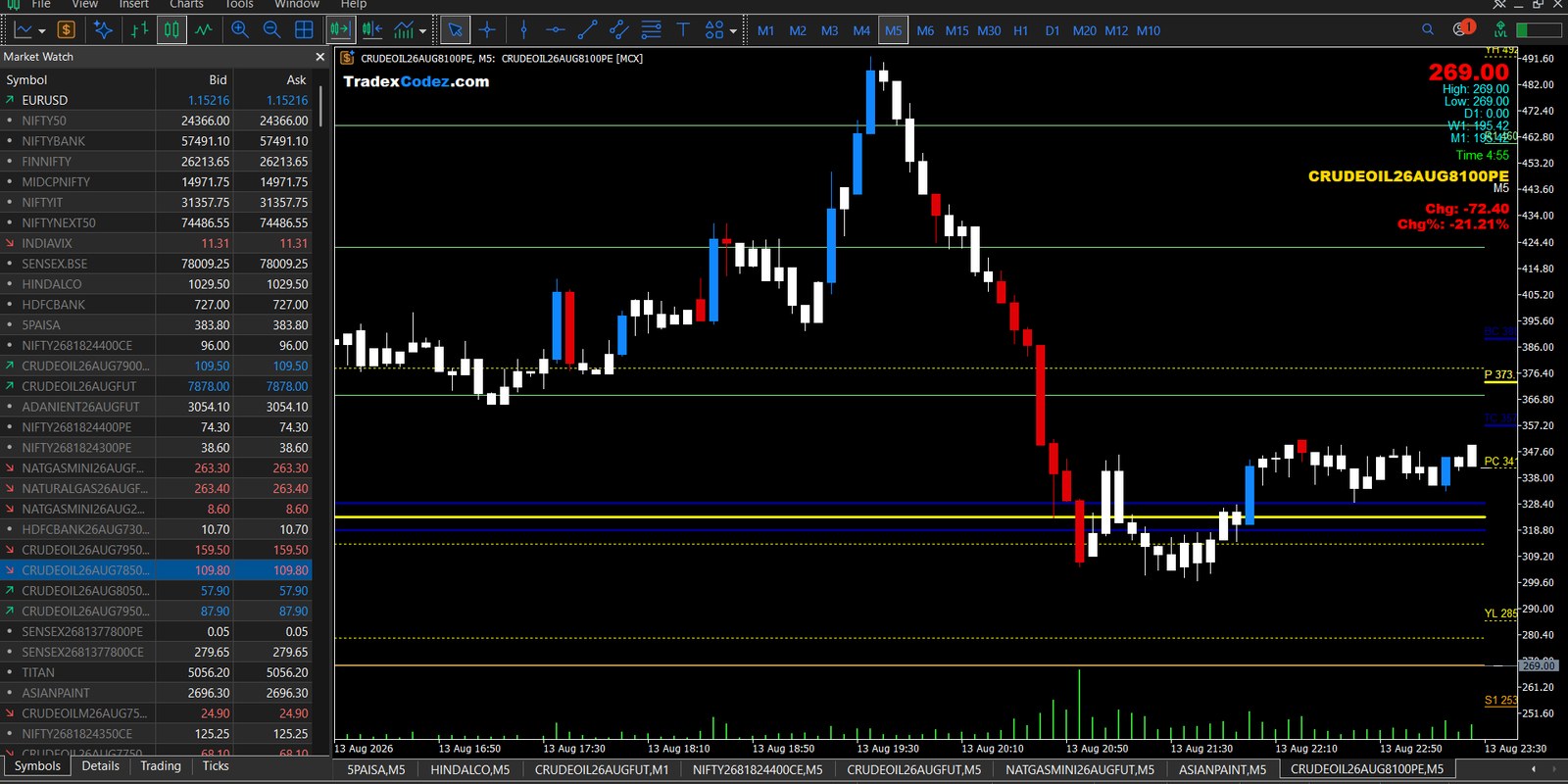
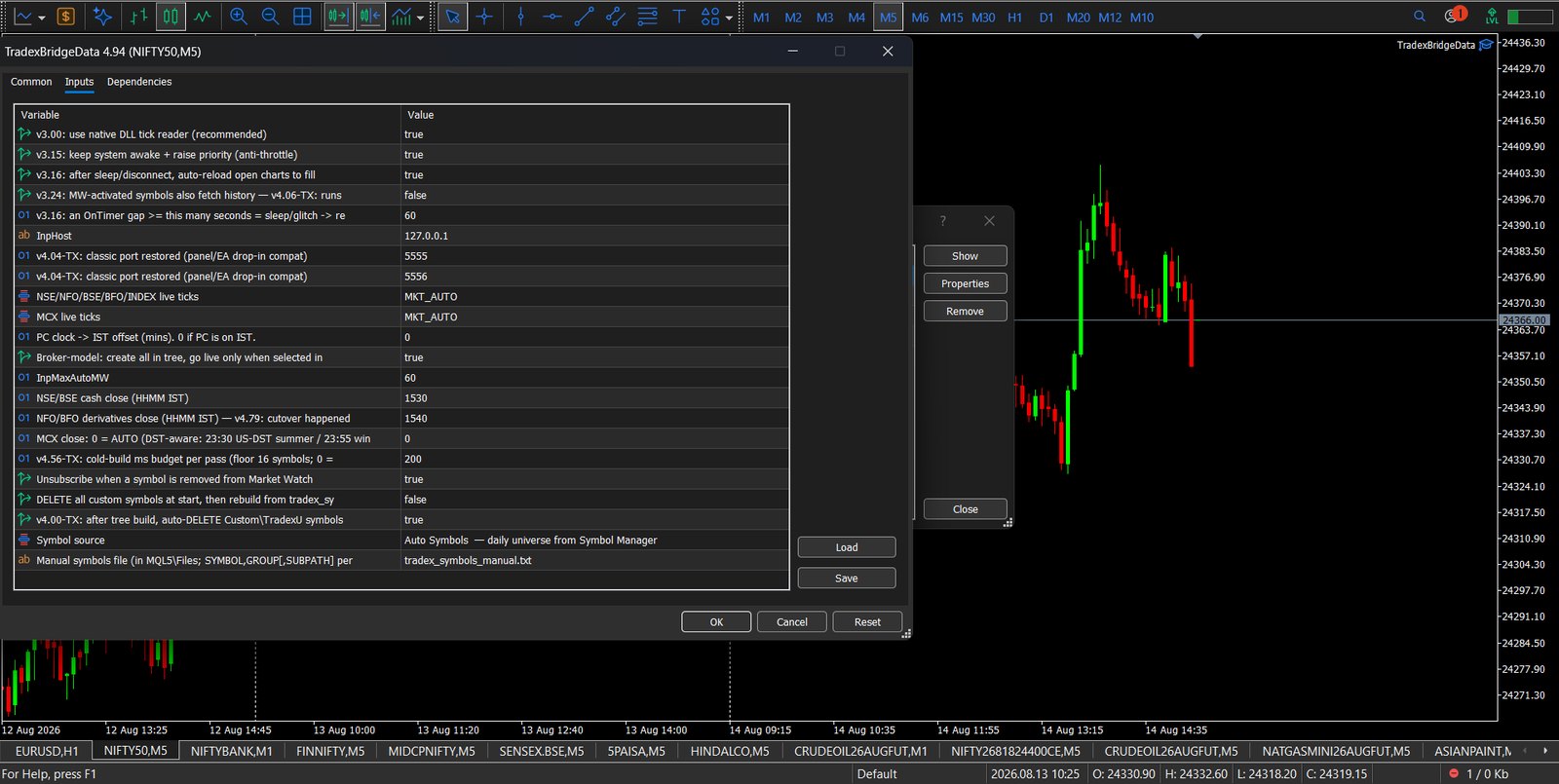
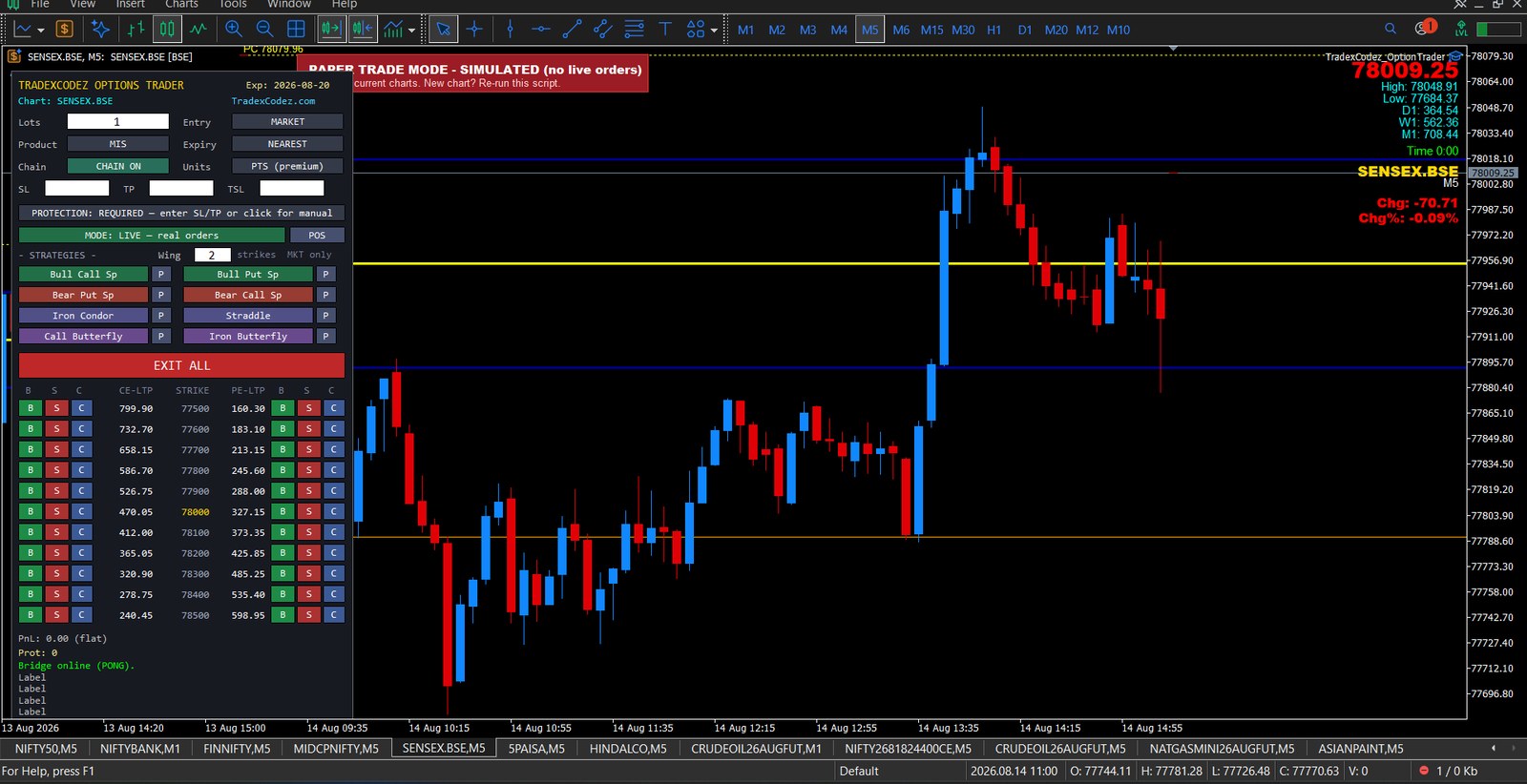
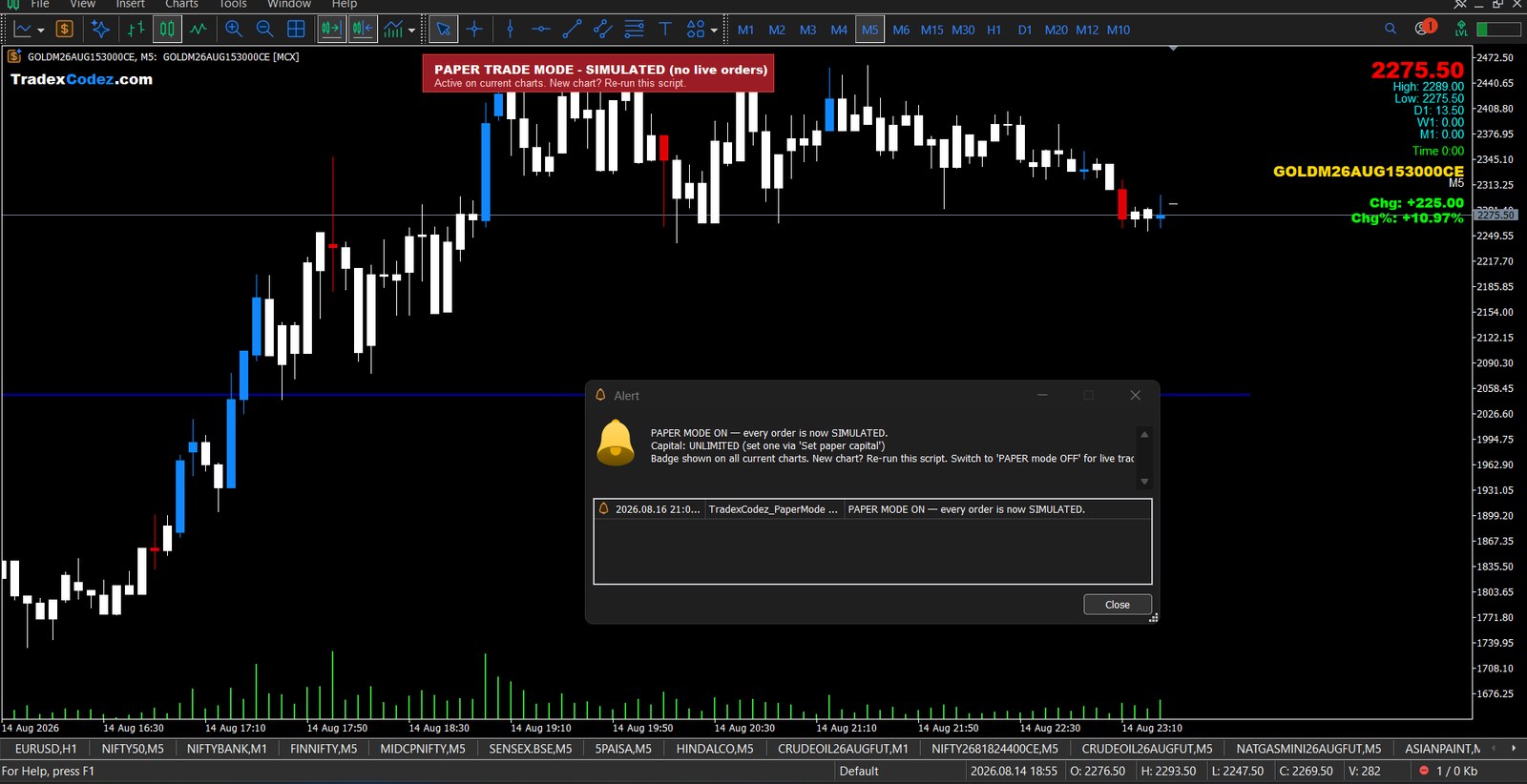
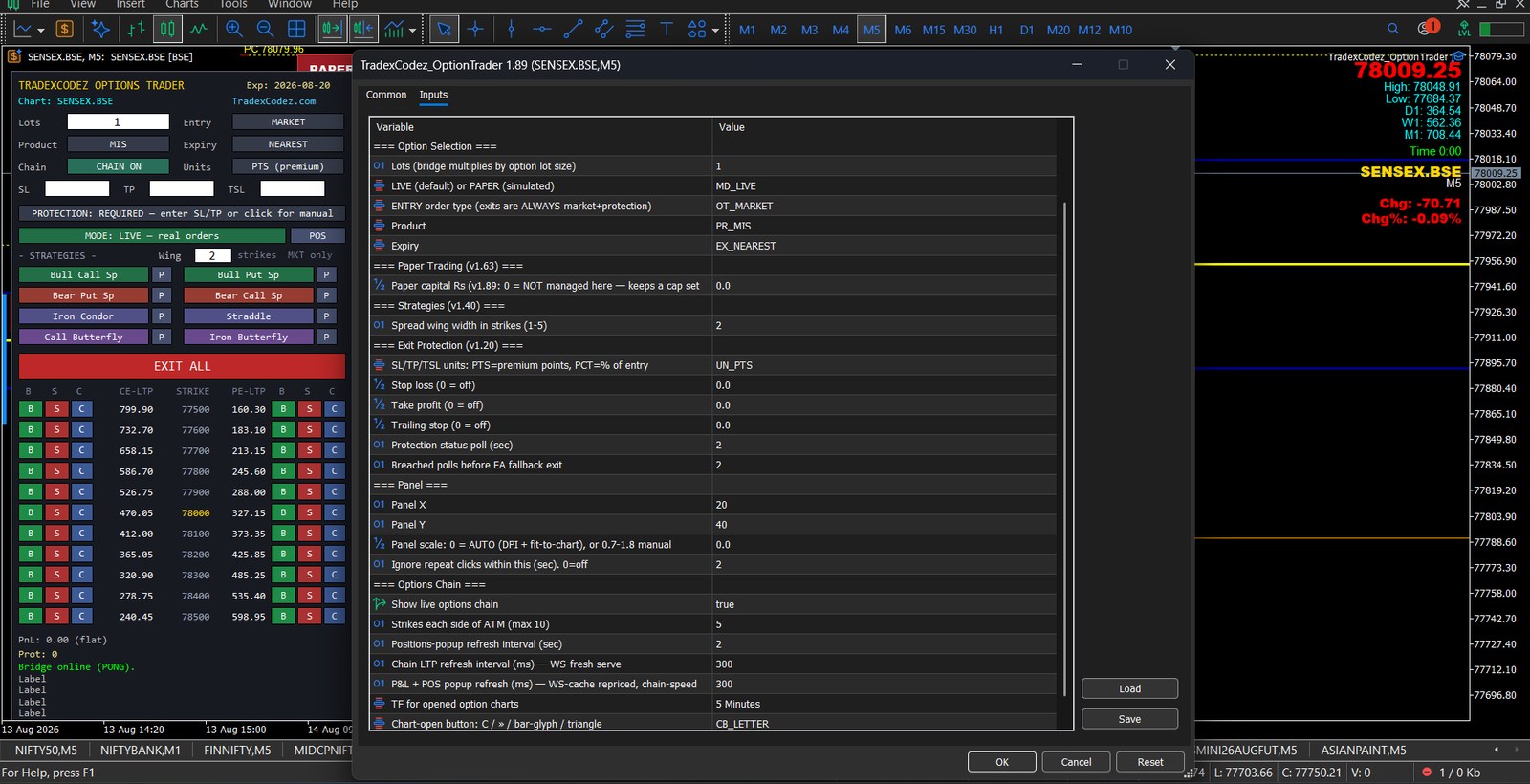
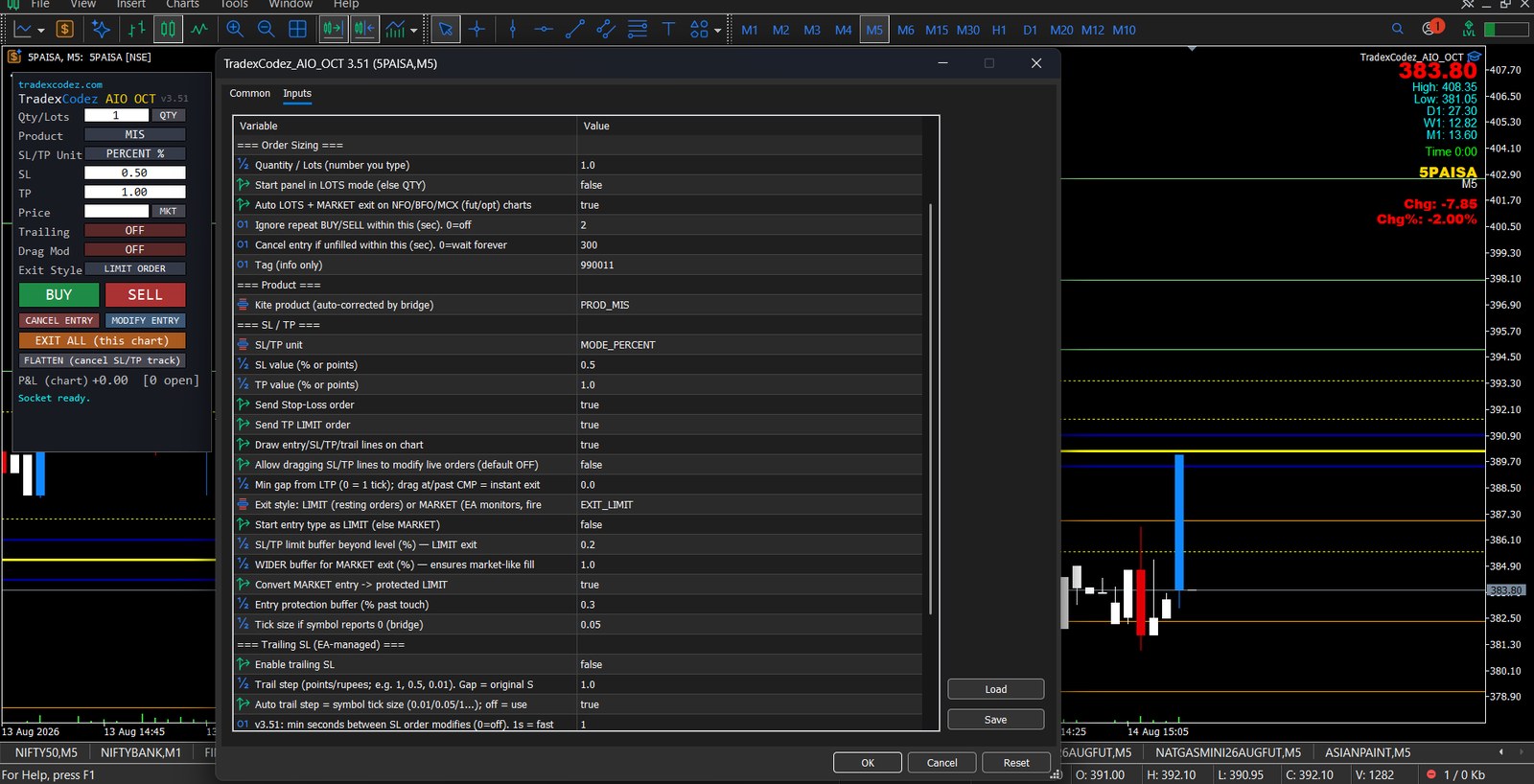
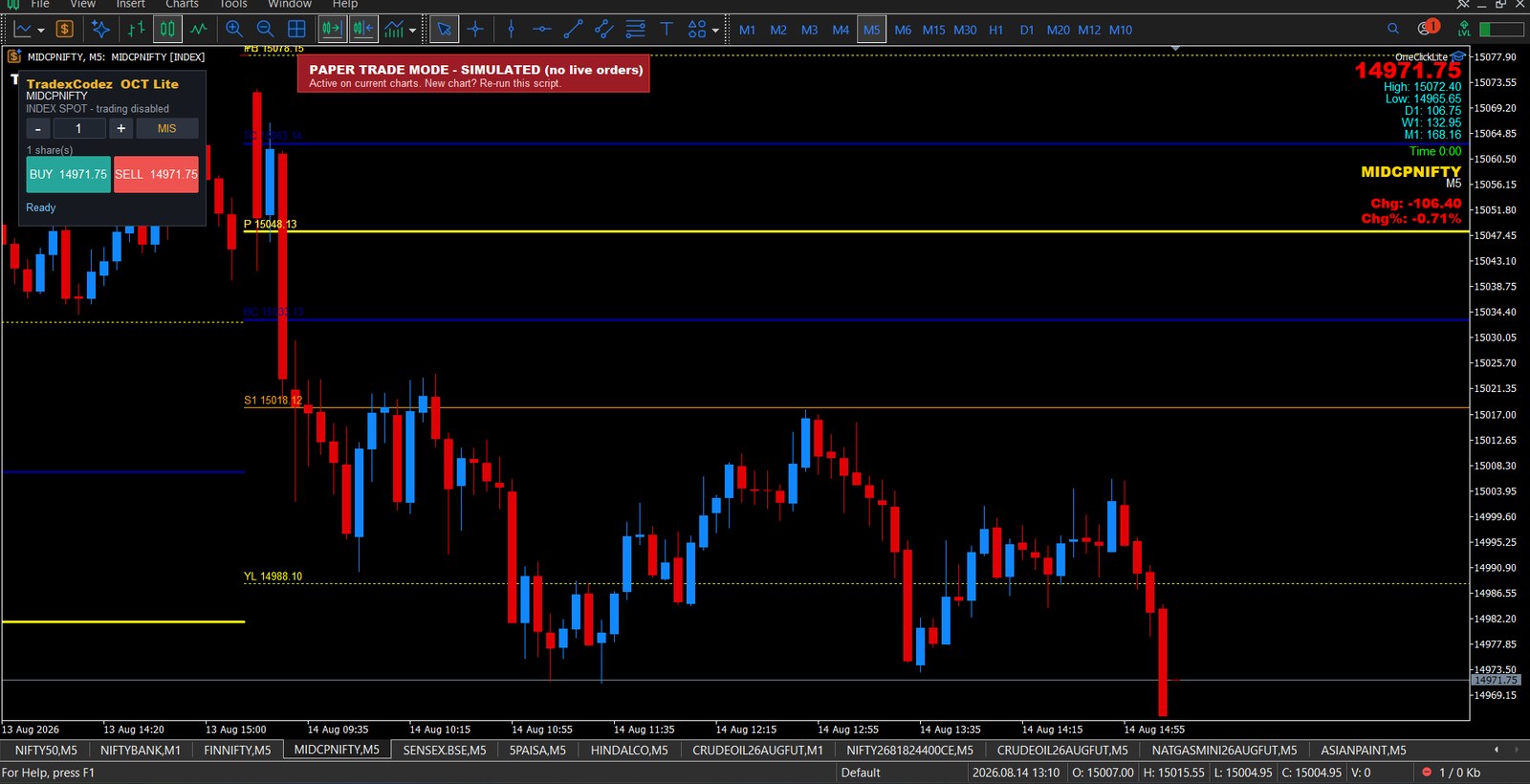
Click any image to open it full size. All captured from a working MetaTrader 5 terminal with the Bridge running against a Zerodha Kite Connect subscription. Charts show 13–14 August 2026 market data.
Trading commodities? The same mechanism applies, but MCX brings its own problems — a fourteen-hour session, monthly contract rollover and overnight gaps. We covered those separately in MCX commodity charts in MetaTrader 5.
See it running
A short walkthrough of what the bridge actually puts on your charts — real-time NSE, NFO, BSE, BFO and MCX instruments inside MetaTrader 5, streamed through your own broker API.
Real-time NSE, BSE & MCX charts in MetaTrader 5
The TradexCodez MT5 Bridge runs on your own Zerodha Kite Connect API — options at any strike, all 21 timeframes, no middleman server. From ₹999/month.
See how the MT5 Bridge works →TradexCodez supplies software only and does not provide investment advice or trading recommendations. MetaTrader is a product of MetaQuotes Software Corp.; Kite Connect is a product of Zerodha Broking Ltd. We are an independent software provider, not affiliated with or endorsed by either. Broker pricing, API limits and exchange timings are set by those parties and can change. Trading carries risk of loss.
